Pro Workshop CONTROL & REPAIR, Spain, December 14-20, 2025 Manu Bonte (10914)
01 January 2026EVENT | paragliding paragliding Technician
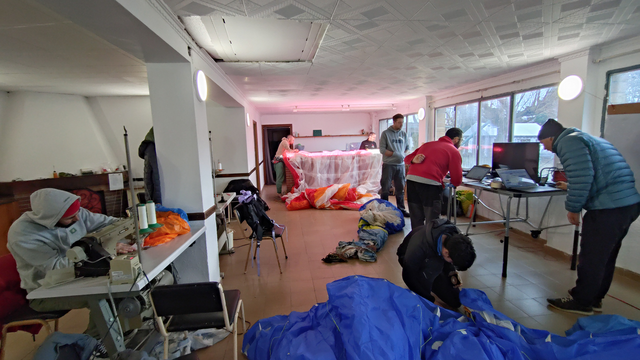
From December 14 to 20, 2024, the Spanish town of Ager hosted an intensive APPI maintenance training program that showcased both the growing international reach of professional paragliding maintenance and the caliber of technicians seeking advanced certification.
**An International Cohort of Specialists**
The group of nine participants showed remarkable profiles. Among them, Nicola Donini, coming from Lago di Garda in Italy, a high-level paragliding athlete had already broad experience. John Krawaritis, from Athens, Greece, showed his potential to become a major player in equipment inspection in his country. Simon Lafond, from the Vosges in France, stood out for his comprehensive approach to training - he has also recently taken over the Flyfat brand. Finally, Brice Davies showed particular commitment to the parakite field.
**Comprehensive Facilities and Expert Instruction**
The venue provided appropriate infrastructure for advanced technical training: a full range of industrial sewing machines, multiple wing inspection stations, precision trim measurement apparatus, and both destructive and non-destructive line testing equipment.
Four instructors led the program: Manu Bonte, Thomas Geli, Vicente Alem, and Jordi Marquillas. Their combined expertise ensured comprehensive coverage of modern maintenance practices, from initial diagnosis through final quality control.
**A Practice-Centered Curriculum**
With approximately 60 hours allocated to hands-on work—representing 80% of total instruction time—participants gained extensive practical experience. The remaining 20 hours of theory provided essential context on material science, aging mechanisms, and APPI's airworthiness standards.
Core competencies developed during the workshop included: systematic diagnostic procedures, trim measurement and adjustment techniques, line fabrication (both sewn and spliced construction), and comprehensive strength testing protocols for evaluating line integrity without destruction.
Throughout all activities, the APPI Control Tool (ACT) served as the operational framework, ensuring participants would return to their workshops with standardized procedures for consistent quality control.
**Advanced Repair Techniques**
Thomas Geli guided participants through progressively complex repair scenarios. Beginning with minor damage correction, the curriculum advanced to structural reconstruction including anchor point repair and the replacement of internal and external wing components. Senior participants tackled repairs reflecting the complexity of contemporary wing designs, working with modern cell architecture and attachment systems.
Jordi Marquillas contributed specialized instruction on reserve parachute systems, covering inspection protocols, packing methodologies, and the integration of various rescue system technologies. His practical insights included efficiency-enhancing tools and techniques developed through extensive workshop experience.
**Ongoing Support and Professional Recognition**
Following the workshop, participants enter a six-month mentorship period during which the instruction team remains available to support the implementation of APPI methodologies. Successful completion of this supervised practice phase leads to APPI maintenance expert qualification.
This credential carries significant industry recognition, with endorsements from 12 paraglider manufacturers to date. The broader APPI maintenance network now encompasses 32 workshops globally and 63 certified maintenance professionals.
**The Critical Role of Professional Maintenance**
These training initiatives address a fundamental safety concern in paragliding: while numerous businesses offer inspection services, many lack the systematic knowledge, standardized procedures, and technical depth necessary for reliable equipment evaluation. APPI's structured approach to technician training and qualification continues to raise professional standards across the industry, directly contributing to pilot safety worldwide.
thumbnails


