Maintenance workshop Colombia 2026 Manu Bonte (10914)
14 March 2026EDUCATION | paragliding paragliding Technician
-Tamesis, Antioquia, Colombia – February 28 to March 7, 2026-
The Colombian municipality of Tamesis hosted the APPI maintenance training program, organized in partnership with the Flyinfrog school. This session vividly illustrated the dynamism of professional paraglider maintenance across Latin America, and the growing maturity of a technical network expanding rapidly across the continent.
-A Cohort with Continental Ambitions
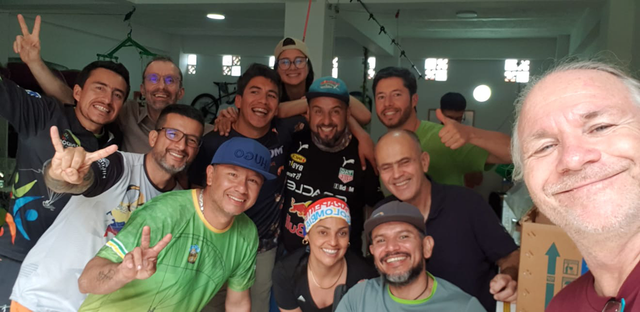
The ten participants reflected the Latin American scope of this gathering. Among them, a Brazilian participant and a Mexican one marked a historic milestone for APPI: the first maintenance workshops formally opened in both Brazil and Mexico — a clear signal that the APPI maintenance network is taking root in new territories across the continent. The remaining participants, all Colombian, arrived with the shared purpose of strengthening and extending the national coverage of certified revision centers.
-A Staff Combining International Expertise and Local Knowledge
Four instructors led the program: Manu Bonte and Thomas Geli, international references in APPI maintenance training, alongside Julian Franco and Sebastian Cuartas, local technicians whose field experience in local conditions brought an invaluable practical dimension. This combination of international perspective and local knowledge ensured a thorough transmission of best practices, fully adapted to the Latin American context.
-A Curriculum Grounded in Practice
Consistent with previous editions, approximately 80% of the time — around 60 hours — was dedicated to hands-on work at the bench, allowing participants to develop concrete, immediately applicable skills. The remaining 20 hours of theory provided the necessary conceptual framework: materials science, fabric and line ageing mechanisms, and APPI airworthiness standards.
Key areas covered included systematic diagnostic procedures, trim measurement and adjustment techniques, line manufacturing — both sewn and spliced — and comprehensive destructive and non-destructive line strength testing protocols. Throughout all activities, the APPI Control Tool (ACT) served as the operational reference, ensuring that participants would return to their workshops with standardized procedures for consistent quality control.
Thomas Geli guided participants through repair scenarios of increasing complexity, from minor damage correction to structural reconstruction of attachment points and replacement of internal and external canopy components. Specialized instruction on reserve parachute systems completed the training, covering inspection protocols, folding methodologies, and the integration of current rescue system technologies.
-A Network That Now Covers the Territory
The most significant impact of this edition lies in its effect on Colombia's geographic coverage. The newly certified technicians extend the APPI revision center network to Popayán, Cali, Bucaramanga, Duitama, and Bogotá, bringing the total number of APPI workshops in Colombia to 14. For the first time, this nationwide coverage offers reasonably equitable access to certified professional maintenance for the entire Colombian pilot community, regardless of their flying region.
-Mentoring and Professional Recognition
Following the workshop, participants enter a six-month mentoring period during which the instruction team remains available to support the implementation of APPI methodologies in their workshops. Successful completion of this supervised practice phase leads to the APPI Maintenance Expert qualification — a credential endorsed by 12 paraglider manufacturers worldwide, and backed by a network now spanning more than 32 workshops and 63 certified professionals globally.
-Maintenance as a Pillar of Safety
This training in Tamesis responds to a genuine need: in a country with as active a paragliding community as Colombia's, the proliferation of inspection services lacking solid technical grounding represents a latent risk. APPI's structured approach — standardized procedures, rigorous assessment, and post-training follow-up — contributes to raising professional standards across the region, and in doing so, directly improves safety for pilots in the air.