
17 June 2026INFO | paragliding
Since spring 2026, Tunisia has been witnessing a major shift in the organisation of paragliding: the gradual introduction of the APPI (Association of Paragliding Pilots and Instructors) training system, in coordination with Tunisian sports authorities. At the heart of this dynamic lies a clear objective: building a coherent, credible, and sustainable pathway, centred on pilot progression, safety, and the development of instructor competencies.
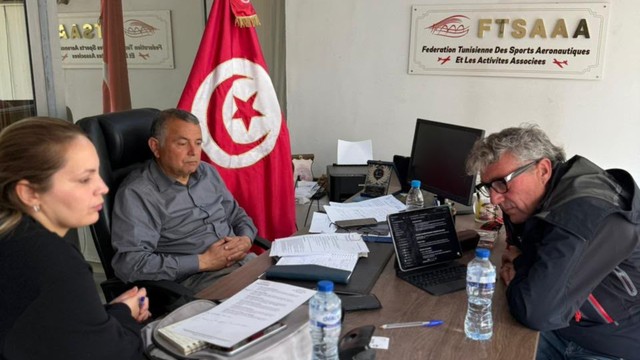
The initiative revolves around institutional work conducted with the Tunisian Federation of Aeronautical Sports and Associated Activities (FTSAAA) and on-the-ground action: meetings with clubs, needs assessments, and the preparation of dedicated training cycles for Tunisian pilots (recreational and professional).
A guiding principle: progress without rushing
In a country with obvious potential for free flight, the challenge is to avoid shortcuts. Those involved insist on a simple idea: in paragliding, safety is not declared, it is built. The project therefore aims for a step-by-step progression, with validated skills, a structured teaching approach, and a carefully designed exposure to risk: progressive, supervised, and controlled.
This philosophy responds to an observed reality on the ground: a sometimes uneven landscape, where training, practices, and skill levels can lack consistency. APPI's ambition in Tunisia is to offer a framework applicable locally while remaining compatible with international recognition.
The APPI-FTSAAA agreement: a partnership in progress
On the institutional front, a cooperation agreement between APPI and FTSAAA has been formalised (in French and English versions). The key provisions establish a foundation: adoption of the APPI system as the training reference framework, implementation of an APPI licence for citizens and residents, recognition of certifications (pilot, tandem, instructor, master), access to teaching resources, and organisation of workshops to train a Tunisian team.
But in this kind of project, one point is decisive: the validation process. Discussions have focused on the need to align the APPI framework with Tunisian requirements and to clarify the respective roles of the federation and the relevant authorities, in particular the Ministry of Sports, and in certain cases, the authorisation procedures related to the activity. The goal: to secure an operational, stable, and legally coherent framework before signing.
A finalisation phase is under way: addressing sensitive clauses, clarifying the certification process, and developing an implementation plan (timeline, insurance, authorisations, communication, monitoring).
On the ground: clubs visited, needs identified
Beyond the documents, action has also been taken in the field. Meetings with organisations and club visits have enabled a diagnostic to be drawn up: the potential of Tunisian sites is significant (cross-country flying, thermals, soaring), but the sector needs clear standards, traceability, and shared reference points.
This ground-level approach is essential: it aims to start from local realities (existing practices, constraints, pilot levels, club expectations) in order to build a progression pathway that is accessible first, then progressively demanding.
Training pilots, tandem pilots, and instructors: scaling up from 2026
In parallel, educational activities have been carried out despite sometimes challenging weather conditions, including practical sessions (training slope) and a theoretical foundation covering key topics: flight mechanics, meteorology, thermals, polar curves, safety, and risk assessment. A debriefing and analysis approach (including video review) completes the learning process.
The next steps are already planned, with a scale-up announced for September 2026 around three complementary formats:
- Tunisian pilot course: progression, safety, and consistent validations.
- International pilot course (notably French): exchanges, collective dynamic, and immersion.
- Pre-instructor workshop: selection, pedagogy, standardisation, and development of a local team.
The professional track, particularly tandem flying and instruction, is a core focus: the aim is to establish rigorous validations, avoid conflicts of interest around sensitive qualifications, and structure a Tunisian progression pathway from assistant instructor to instructor, and ultimately to master level.
Local partnerships running in parallel: the Bizerte example
Alongside the APPI-FTSAAA agreement, local partnership agreements are emerging, notably around Bizerte, to define the terms of training activities, traceability, responsibilities, and communication rules. This two-tier strategy (institutional + local partnerships) aims to make the framework concrete, operational, and replicable.
Building towards autonomy: a Tunisian team as the end goal
The stated objective is clear: for the system to operate autonomously in Tunisia, led by Tunisian instructors and masters. The project therefore includes, in the medium term, identifying and developing the profiles capable of driving the sector locally.
In this logic, bringing pilots over through courses and exchanges is not merely a tourism-oriented activity: it is a lever to accelerate experience, build a shared culture, strengthen credibility, and maintain high standards.
A sporting showcase: planned presence in late October 2026
The calendar also includes an important milestone: the intention to be present at the precision landing competition from 29 to 31 October 2026, conceived as a showcase for the overall coherence of the project (training, safety, performance), and as a moment for visibility and networking.
The role of Stéphane Henry: continuity and pedagogical guarantee
In this sequence, Stéphane Henry, as an APPI Master, acts as the operational pivot: coordination with stakeholders, pedagogical coherence, pathway development, and monitoring of key stages. For APPI, the presence of a master is essential: not to "move fast", but to ensure that progression remains structured, and that safety becomes a competency, not a slogan.
thumbnails


